In the rapidly evolving digital economy of 2026, the question for every serious investor is no longer just when to buy, but where to buy to maximize profitability. As Bitcoin continues to cement its role as a cornerstone of modern portfolios, the “fee war” between traditional brokers and native cryptocurrency exchanges has reached a fever pitch. Every fraction of a percentage point you lose to a trading fee or a hidden spread is a direct hit to your long-term compounding potential.
For the community at tradesmartcrypto.com, achieving trading success requires a disciplined approach to cost management. Whether you are a high-frequency day trader or a long-term HODLer, understanding the structural differences between “Simple” exchanges like Binance and professional brokerage firms like Interactive Brokers is the first step in optimizing your risk management strategy. In 2026, the “best” platform isn’t just the one with the best UI—it’s the one that leaves the most capital in your wallet.
The Great 2026 Fee Showdown: Centralized Exchanges vs. Professional Brokers
The choice between a native crypto exchange (CEX) and a traditional broker depends entirely on your trading volume and your need for technical depth. While “vibrant” exchanges have simplified the onboarding process, professional brokers have integrated blockchain technology to offer institutional-grade pricing that often undercuts the big names in the crypto space.
1. Native Crypto Exchanges: The Power of Binance, Bybit, and MEXC
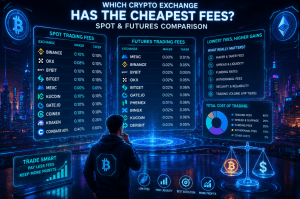
Native exchanges like Binance, Bybit, Bitget, and MEXC remain the most popular choices for retail traders because of their massive liquidity and ease of use. These platforms typically operate on a “maker-taker” model. In 2026, a standard “taker” fee on Binance or Bybit is approximately 0.10%, which can be further reduced to 0.075% if you use native tokens like BNB for payment.
The standout in this category for 2026 is often MEXC, which has gained massive traction by offering 0.00% maker fees on spot trading. This is a powerful tool for traders who use limit orders and have the patience to wait for the market to come to them. However, users must stay vigilant regarding withdrawal fees and “hidden” spreads, which can sometimes negate the savings of a zero-fee headline. For those focused on technical market forecasting, these platforms offer the best integration for dynamic charts and live price feeds.
2. The Professional Broker Advantage: Interactive Brokers (IBKR)
The biggest shift in 2026 has been the aggressive entry of traditional brokers into the Bitcoin spot market. Interactive Brokers (IBKR) has become a formidable rival to Binance by offering a transparent commission structure that appeals to high-net-worth individuals and professional firms.
Through partners like Paxos or Zero Hash, IBKR now allows users to trade Bitcoin with commissions as low as 0.12% to 0.18% of the trade value. While this might look higher than MEXC’s 0%, IBKR offers something native exchanges often lack: no added spreads or markups. In a native exchange, you might pay a 0.1% fee but lose 0.5% to a wide bid-ask spread. IBKR provides direct market access (DMA), ensuring that you are getting the true live price of the asset. Furthermore, for users who already hold stocks or ETFs, IBKR provides a unified dashboard that simplifies tax reporting and portfolio management.
3. Understanding the “Hidden” Costs: Spreads vs. Commissions
To trade Bitcoin with the lowest fees, you must understand the difference between the “sticker price” (the commission) and the “real cost” (the spread). A “Simple” buy on a standard app might advertise “No Commission,” but they often bake a 1.5% to 2.0% markup into the Bitcoin price itself.
Professional traders use technical indicators to monitor liquidity. On a highly liquid exchange like Solana or Bitcoin pairs on Binance, the spread is razor-thin. On a broker like IBKR, you are often interacting with institutional liquidity pools, which keeps the spread tight even during periods of high volatility. If you are executing large orders, the broker model often results in a lower “total cost of execution” than a retail-focused exchange.
4. Advanced Strategies: Limit Orders and Taker Fees
One of the most effective ways to lower your fees is to move away from “Market” orders. By using a “Limit” order, you become a market maker, adding liquidity to the order book. Most platforms, including XRP and Cardano hubs, offer significant discounts for makers.
For example, while a “taker” might pay 0.1%, a “maker” might pay only 0.02% or even receive a rebate. Mastering the use of support and resistance levels allows you to place limit orders at strategic points, ensuring you get the best price and the lowest fee. This is a core part of trading psychology; it requires the discipline to wait for the price to hit your target rather than chasing a pump.
5. Comparing Institutional Tools: IBKR vs. Coinbase One
In 2026, we also see the rise of subscription-based models like Coinbase One. For a monthly fee, users can trade up to $10,000 with “zero” commissions. However, when compared to Interactive Brokers, the spread on Coinbase can still be a significant factor.
The choice comes down to frequency. If you trade 50 times a month with small amounts, a subscription might save you money. If you are making 2 or 3 large, strategic entries into low-cost cryptocurrencies, the per-trade commission at a broker like IBKR or the low-fee structure of Kraken Pro will almost always be the more economical choice.
6. The Impact of Deposit and Withdrawal Fees
The “trap” many new traders fall into is ignoring the cost of moving money. A platform might have 0% trading fees but charge 3% for a credit card deposit or a flat $20 fee for every Bitcoin withdrawal.
In 2026, the most cost-effective path is often using SEPA or ACH transfers, which are usually free on both brokers and major exchanges. For withdrawals, look for platforms that offer crypto wallet integrations with lightning network support to keep gas fees at a minimum. Professional brokers often have more rigid withdrawal processes, but they are generally cheaper for large fiat-to-bank transfers than native exchanges.
7. Final Verdict: How to Choose Your Path
To minimize your fees in 2026, you must align your platform with your trading philosophy.
- For Active Day Traders: Use Binance or Bybit with a BNB/native token discount and stick to limit orders to capture maker rebates.
- For Wealth Management & Large Sizes: Use Interactive Brokers to access institutional spreads and a regulated environment that protects your capital.
- For Bitcoin-Only DCA: Look for specialized providers like Strike or River that offer zero-fee recurring buys, though always check their spread against the global live price.
Optimizing your fees is an ongoing process. As you advance from learning the basics to mastering Wyckoff methods, your platform needs will change. Stay informed, stay disciplined, and always look for the “hidden” spread before you click buy.