It was 1:18 a.m. when Daniel closed his Bitcoin chart.
He had just finished a futures trade.
The trade itself wasn’t bad.
Bitcoin moved exactly in the direction he expected.
Daniel made $84.
He smiled.
Then he opened his trading history.
His smile disappeared.
“Wait… why did I pay this much?”
He looked at the entry fee.
Then the exit fee.
Then funding.
Then the spread.
Then he remembered something else: he had made several trades earlier that week.
The strategy was profitable.
But the fees were quietly eating part of his profits.
The next morning, Daniel called his friend Alex.
“I think I need to change exchanges.”
Alex laughed.
“Because your exchange is bad?”
“I don’t know. I just realized that I never actually compared the fees.”
That conversation started a much bigger investigation.
Daniel wanted to answer one simple question:
Which crypto exchange has the cheapest fees for futures and spot trading?
What he discovered was more complicated than he expected.
There wasn’t one exchange that was cheapest at everything.
The answer depended on what you trade, how often you trade, whether you use spot or futures, whether you make or take liquidity, and what fee discounts you qualify for.
And that is exactly what every crypto trader should understand before choosing an exchange.
Why Crypto Exchange Fees Matter More Than Most Traders Think
Daniel had always focused on the obvious numbers.
Entry price.
Exit price.
Profit percentage.
Leverage.
But he rarely calculated his total trading costs.
That was a mistake.
Suppose a trader makes 100 trades.
Even a small difference in trading fees can become significant when multiplied across dozens or hundreds of transactions.
This is especially important for:
- Scalpers
- Day traders
- Futures traders
- High-frequency traders
- Traders who frequently enter and exit positions
- Traders using large position sizes
A long-term investor who buys Bitcoin once a month may care less about a tiny difference in trading fees.
A futures scalper making 20 trades in a day has a completely different problem.
Daniel finally understood:
“The cheapest exchange isn’t necessarily the exchange with the lowest advertised number. It’s the exchange that gives me the lowest total cost for the way I trade.”
Maker vs Taker: The First Thing Daniel Had to Understand
Daniel’s first discovery was something he had previously ignored.
Crypto exchanges generally divide trading fees into two basic categories:
What Is a Maker Fee?
A maker places an order that adds liquidity to the order book.
For example, Daniel places a limit order that doesn’t immediately execute.
If that order sits on the order book and another trader eventually takes it, Daniel may receive the maker fee.
What Is a Taker Fee?
A taker removes liquidity from the order book.
For example, Daniel uses a market order and immediately buys Bitcoin at the available price.
He is acting as a taker.
Taker fees are often higher than maker fees.
That difference can become extremely important for active traders.
Daniel opened his exchange account and asked:
“How many of my trades are actually makers?”
The answer surprised him.
Most of his trades were taker orders.
So comparing only maker fees would have given him the wrong answer.
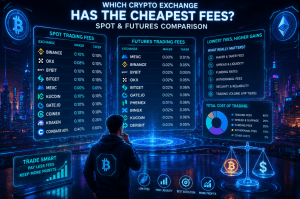
The Big Crypto Exchange Fee Comparison
Daniel decided to compare the major exchanges rather than looking at only one or two.
His list included some of the biggest names in the industry:
- Binance
- Bybit
- OKX
- Bitget
- MEXC
- Gate
- KuCoin
- BingX
- CoinEx
- Phemex
- Kraken
- Coinbase
- Crypto.com
- Bitfinex
- HTX
- BitMart
- WhiteBIT
- Deribit
But immediately he ran into another problem.
Not every exchange uses the same fee structure.
Some exchanges are especially competitive in futures.
Others are stronger for spot trading.
Some offer aggressive discounts through their native tokens.
Others have different rates depending on the user’s country.
And almost all of them have VIP programs that can dramatically reduce fees.
So Daniel created two separate comparisons.
Spot trading.
And:
Futures trading.
Which Exchange Has the Cheapest Spot Trading Fees?
For spot trading, Daniel noticed that several major exchanges were highly competitive at their standard base tiers.
Binance
Binance has historically been among the most competitive major exchanges for standard spot trading fees, with a commonly published base rate around 0.10% maker / 0.10% taker, before applicable discounts.
Its large liquidity is another important advantage.
A low fee is not the only thing that matters.
If an exchange has poor liquidity for the asset you want to trade, a theoretically lower fee can be offset by spread and slippage.
Daniel wrote:
“Fee + spread + slippage = real trading cost.”
That became one of his most important rules.
OKX
OKX is also highly competitive for spot trading.
Its standard fee structure can be lower than some traditional exchanges, with different maker and taker rates depending on the user’s account tier and market.
For active traders, OKX becomes particularly interesting when trading volume qualifies the account for better tiers.
Bybit
Bybit is another major exchange that offers competitive spot fees.
Its standard spot rates are generally around the same broad range as other large low-fee exchanges, while higher-volume users can receive reduced rates.
For traders already using Bybit for derivatives, the ability to trade both spot and futures within the same ecosystem can also be convenient.
Bitget
Bitget has also positioned itself as a low-fee exchange, particularly for derivatives.
Its spot fees are competitive with other large exchanges, while its futures products make it especially attractive to active derivatives traders.
MEXC
MEXC deserves special attention when comparing low-cost trading.
The exchange has frequently used aggressive fee promotions and low-fee structures to attract active traders.
However, Daniel learned an important lesson:
Never compare an exchange using a promotional fee without checking whether that promotion applies to the exact coin, trading pair, product and region.
A “0% fee” headline doesn’t necessarily mean every trade on the platform costs zero.
Which Exchange Has the Cheapest Futures Fees?
This was the part Daniel cared about most.
Futures traders often pay close attention to maker and taker fees because they may open and close positions much more frequently.
Several exchanges are highly competitive here.
Binance Futures
Binance Futures has traditionally offered very competitive base-level derivatives fees.
A commonly published standard level is approximately:
Maker: 0.02%
Taker: 0.05%
The exact rate can vary depending on product, account tier, discounts and other conditions.
For Daniel, Binance immediately became one of the strongest candidates.
Bybit Futures
Bybit is another major competitor.
Its commonly published base derivatives fees have been around:
Maker: 0.02%
Taker: 0.055%
Again, account tiers and other conditions can reduce these numbers.
Bybit became particularly interesting to Daniel because it combines deep derivatives liquidity with a competitive fee structure.
OKX Futures
OKX is also among the exchanges worth comparing for futures.
Its standard derivatives structure is highly competitive, commonly around the low basis-point range for makers and approximately 0.05% for takers, depending on the product and account tier.
For an active trader, this can make a meaningful difference over hundreds of trades.
Bitget Futures
Bitget has become a major derivatives platform and offers competitive futures fees.
Its standard futures rates are commonly around:
Maker: 0.02%
Taker: 0.06%
The exact rate can vary according to account level and product.
MEXC Futures
MEXC is one of the exchanges Daniel investigated carefully because of its reputation for aggressive low-fee offerings.
Its futures fees can be extremely competitive, particularly during promotional periods and depending on the product.
But this is where Daniel refused to make the mistake of declaring:
“MEXC is always the cheapest.”
That statement would be too simple.
Fee promotions change.
Trading pairs differ.
User tiers differ.
And the cheapest headline fee does not necessarily produce the cheapest overall execution.
The Exchange With the Lowest Fee Isn’t Always the Cheapest
Daniel then discovered something even more important.
Imagine Exchange A charges:
0.04%
Exchange B charges:
0.05%
At first glance, Exchange A appears cheaper.
But suppose Exchange A has a wider spread.
Daniel wants to buy $10,000 worth of a relatively illiquid coin.
If the spread and slippage cost him another $10 or $20, the lower commission may no longer matter.
Exchange B could actually produce the cheaper transaction.
This is why experienced traders don’t look at the commission alone.
They look at the total cost of execution.
The Hidden Cost Daniel Had Forgotten: Funding Fees
Daniel had another surprise waiting for him.
He was trading perpetual futures.
Unlike a simple spot transaction, perpetual futures can involve funding payments between long and short traders.
Funding isn’t the same thing as an exchange trading commission.
Depending on market conditions, Daniel could pay funding or receive it.
He realized that a futures trader comparing exchanges only by maker and taker fees was missing part of the picture.
A better calculation was:
Total futures cost = trading fees + spread + slippage + funding + other applicable costs
That changed his entire comparison.
Spot vs Futures: Which Exchange Is Actually Cheapest?
Daniel created a simple shortlist.
Best All-Around Low-Fee Candidates
For a trader looking for competitive fees across both spot and futures, Daniel placed several major exchanges on his research list:
Binance
Strong combination of competitive spot fees, competitive futures fees and deep liquidity.
OKX
Competitive spot and derivatives pricing with strong trading infrastructure.
Bybit
Particularly attractive for active derivatives traders while also offering competitive spot trading.
Bitget
Competitive futures fees and a strong derivatives focus.
MEXC
Potentially extremely competitive for certain markets and promotions, but traders need to check the exact current fee schedule.
Gate
A large selection of assets and competitive trading fees, although the total execution cost depends heavily on the specific market.
KuCoin
Competitive base fees and a large selection of cryptocurrencies, with discounts available at higher tiers.
BingX
Another exchange worth comparing for active futures traders because of its competitive derivatives fee structure.
Daniel didn’t choose a winner immediately.
He realized that “cheapest” depended on his own trading style.
What About Coinbase and Kraken?
Then Daniel checked two exchanges that beginners often recognize first.
Coinbase.
And Kraken.
He quickly discovered why comparing only brand names can be misleading.
Coinbase
Coinbase is a major and highly established crypto platform, but its standard trading fees can be significantly higher than the lowest-fee offshore/global exchanges, particularly for smaller-volume users.
Coinbase Advanced uses a maker/taker model, and fees vary according to trading volume.
Therefore, Coinbase isn’t normally the first exchange Daniel would choose if his only objective was minimizing trading commissions.
However, fees are only one factor when choosing an exchange.
Regulation, availability, custody, fiat support, security and jurisdiction also matter.
Kraken
Kraken also uses a volume-based maker/taker structure.
Its fees can be competitive for higher-volume traders, but its standard fees are generally not the absolute lowest among the major global exchanges.
Again, Daniel refused to call it a “bad exchange.”
He simply separated two questions:
“Is this exchange good?”
and:
“Is this exchange the cheapest?”
Those are completely different questions.
What About Bitfinex, Crypto.com, CoinEx and Phemex?
Daniel expanded his spreadsheet.
Bitfinex
Bitfinex offers a tiered maker/taker structure and can become more competitive as trading volume increases.
It can be worth considering for traders whose volume qualifies them for lower tiers.
Crypto.com
Crypto.com also uses a tiered fee structure.
Its rates depend on trading volume and other conditions, so a high-volume trader may see considerably different fees from a beginner.
CoinEx
CoinEx is another exchange frequently considered by traders looking for competitive fees and a broad selection of assets.
However, its standard fee structure differs from the lowest-cost leaders, so traders should compare the exact market and account tier.
Phemex
Phemex has historically positioned itself strongly around derivatives and competitive futures pricing.
For futures traders, it deserves a place on the comparison list rather than being judged only by its spot fees.
Why VIP Levels Change Everything
Daniel had been comparing beginner fees.
Then Alex asked:
“What happens when you trade a lot?”
Daniel opened the VIP fee pages.
That changed the numbers.
Most major exchanges use tiered pricing.
The more you trade, the lower your fees can become.
Some platforms also consider:
- 30-day trading volume
- Account assets
- Exchange token holdings
- Maker/taker activity
- Institutional status
- Derivatives volume
- Other qualification requirements
This means a professional trader and a beginner may use the same exchange but pay very different rates.
The Cheapest Exchange for a Beginner May Not Be the Cheapest for a Professional
This is one of the biggest mistakes in online exchange comparisons.
A website might advertise a very low VIP fee.
But a new trader may not qualify for that tier.
Daniel therefore created two columns in his spreadsheet:
Base fee
and:
Possible VIP fee
Now his comparison finally made sense.
The Exchange Token Discount Trap
Some exchanges provide discounts when users pay trading fees with the platform’s native token.
That can reduce the effective fee.
But Daniel asked another question:
“Should I buy an exchange token just to save on fees?”
The answer wasn’t automatically yes.
If a trader buys a volatile token solely to receive a small fee discount, the value of that token can move more than the money saved on commissions.
Daniel preferred to treat exchange-token discounts as an additional factor rather than the primary reason to choose an exchange.
Daniel’s Final Ranking
After several nights of research, Daniel wrote his conclusion.
He didn’t write:
“Exchange X is the cheapest.”
Instead, he wrote:
For Low-Cost Spot Trading
Binance, OKX, Bybit, Bitget and MEXC were among the exchanges he would compare first for competitive standard spot pricing.
Other major exchanges such as Gate, KuCoin, BingX and CoinEx could also be competitive depending on the market and account tier.
For Low-Cost Futures Trading
For derivatives, Daniel’s first comparison group became:
Binance, OKX, Bybit, Bitget, MEXC, Gate, BingX and Phemex.
But he would always check the current fee schedule before trading.
For the Lowest Possible Fee
Daniel learned that the answer often depends on:
maker vs taker + VIP tier + trading pair + product + region + discounts + spread + slippage + funding.
That is the real answer.
The 100,000 Dollar Example
Alex challenged him.
“Show me why fees actually matter.”
Daniel opened his calculator.
Suppose a trader executes $100,000 of trading volume.
A difference of only 0.01% in fees equals:
$10
Now multiply that across $1 million in trading volume:
$100
And $10 million:
$1,000
For a trader generating enormous volume, even tiny fee differences become meaningful.
But Daniel added another warning:
A trader shouldn’t choose an exchange solely to save $100 if the exchange introduces significantly higher execution costs, lower liquidity, security concerns or restrictions that make the platform unsuitable.
That was the balance he had been missing.
The Cheapest Exchange Is Not Necessarily the Best Exchange
Daniel’s spreadsheet was finally complete.
But his conclusion surprised Alex.
“So which exchange are you moving to?”
Daniel closed his laptop.
“I haven’t decided.”
“After all that research?”
“Yes.”
Alex laughed.
“Then what was the point?”
Daniel smiled.
“Now I know what I’m actually comparing.”
He explained that a crypto exchange should be judged on several dimensions:
- Trading fees
- Maker/taker structure
- Futures fees
- Spot fees
- Liquidity
- Spread
- Slippage
- Funding rates
- Withdrawal fees
- Deposit options
- Security
- Available trading pairs
- Regulatory and regional availability
- Account limits
- User experience
Trading fees were only one part of the equation.
A Better Way to Choose Your Crypto Exchange
Before opening an account, Daniel recommended creating a simple checklist.
If You Mainly Trade Spot
Check:
- Maker fee
- Taker fee
- Trading pair liquidity
- Spread
- Withdrawal fee
- Available coins
- Deposit methods
- Security and regulatory availability
If You Mainly Trade Futures
Check:
- Maker fee
- Taker fee
- Funding rate
- Futures liquidity
- Spread
- Slippage
- Maximum leverage
- Liquidation rules
- Insurance/ADL mechanisms
- Regional availability
If You Are a Beginner
Don’t immediately choose the exchange with the lowest number.
First understand your own trading behavior.
Are you a:
Long-term investor?
Swing trader?
Day trader?
Scalper?
Futures trader?
Your answer changes the importance of fees.
Trade Smart Crypto’s trading philosophy explains why having a defined approach matters before jumping from one market or exchange to another.
One More Lesson: Don’t Let Cheap Fees Encourage Overtrading
Daniel discovered one final problem.
An exchange with extremely low fees can make trading feel almost free.
That can be dangerous.
A trader might think:
“The fee is tiny, so I’ll just take another trade.”
Then another.
And another.
Suddenly the trader has made 30 unnecessary trades.
Even low fees add up.
More importantly, unnecessary trading creates unnecessary risk.
This is why Daniel connected his exchange decision with his risk management and trading discipline.
The objective isn’t to trade as much as possible.
The objective is to make good decisions.
So, Which Crypto Exchange Has the Cheapest Fees?
After comparing the major exchanges, Daniel finally had his answer.
There isn’t one universal winner.
For competitive spot fees, exchanges such as Binance, OKX, Bybit, Bitget and MEXC are among the major platforms worth comparing.
For competitive futures fees, Binance, OKX, Bybit, Bitget, MEXC, Gate, BingX and Phemex are important candidates.
For large-volume traders, VIP programs can completely change the ranking.
And for real-world trading cost, commission is only part of the equation.
The cheapest exchange on paper may not be the cheapest exchange after:
spread + slippage + funding + withdrawal costs + account tier + execution quality
are included.
Daniel finally wrote one sentence at the bottom of his spreadsheet:
“Don’t search for the exchange with the lowest fee. Search for the lowest total cost for the way you trade.”
That was the answer he had been looking for all along.
And before his next trade, he did something he had never done before.
He checked the fee schedule.
Then he checked the spread.
Then liquidity.
Then funding.
Then his risk.
Only after all of that did he open the trade.
Because saving a fraction of a percent is useful.
But knowing why you are trading is worth much more.